
Shri Parijnanashram Trayodashi - Shloka 3
A Website Committee Presentation for the Parijñānalaharī Mahotsavaḥ, (15 June 2026 to 12 October 2027)
Shrī Parijñānāshram Trayodashī is a lyrical stotra of 13 shloka-s offering salutations to our 10th Mat͟hādhipati, H.H. Shrīmat Parijñānāshram Swāmījī III. Chanting this divine stotra daily bestows upon us the Benevolence of our Parama Guru and Guruparamparā.
It was the dearest wish of our beloved H.H. Shrīmat Sadyojāt Shaṅkarāshram Swāmījī to dedicate a stotra in Sanskrit to our Parama Guru Swāmījī, sequentially unfolding His life and works. In Beṅgal̃ūru, H.H. Swāmījī serendipitously found the erudite scholar, Shatāvadhānī Dr. R. Gaṇesh who completed the stotra in 2006.
This series of 13 articles based on the stotra, highlights the inspiring life of H.H. Shrīmat Parijñānāshram Swāmījī III, dedicated to the welfare and betterment of sādhaka-s and society. We humbly bow down in limitless gratitude to our Divine Parama Guru to seek His Blessings.
Shloka 3 - The Alaukika Bond between Our Parames͟ht͟hī Guru Swāmījī and Parama Guru Swāmījī
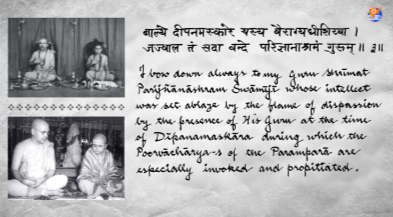
In 1947, Bhārat was heading towards independence, after suffering about 200 years of British Rule. In the same year on 15th June, Sunday, Shrī Shaṅkaranārāyaṇ Shukla and Smt. Shāntābāī Shukla were blessed with a bonny, rosy-cheeked baby. As he was born on Sarvajit Nāma Saṁvatsara, Jyes͟ht͟ha Māsa, Kṛs͟hṇa Paks͟ha Ekādashī, at 12 noon on Shubha Ravivāra, they named the baby ‘Ravīndra’. Growing up, little Ravīndra soon became the darling of the family, with his sunny smile, twinkling eyes and heart of gold.
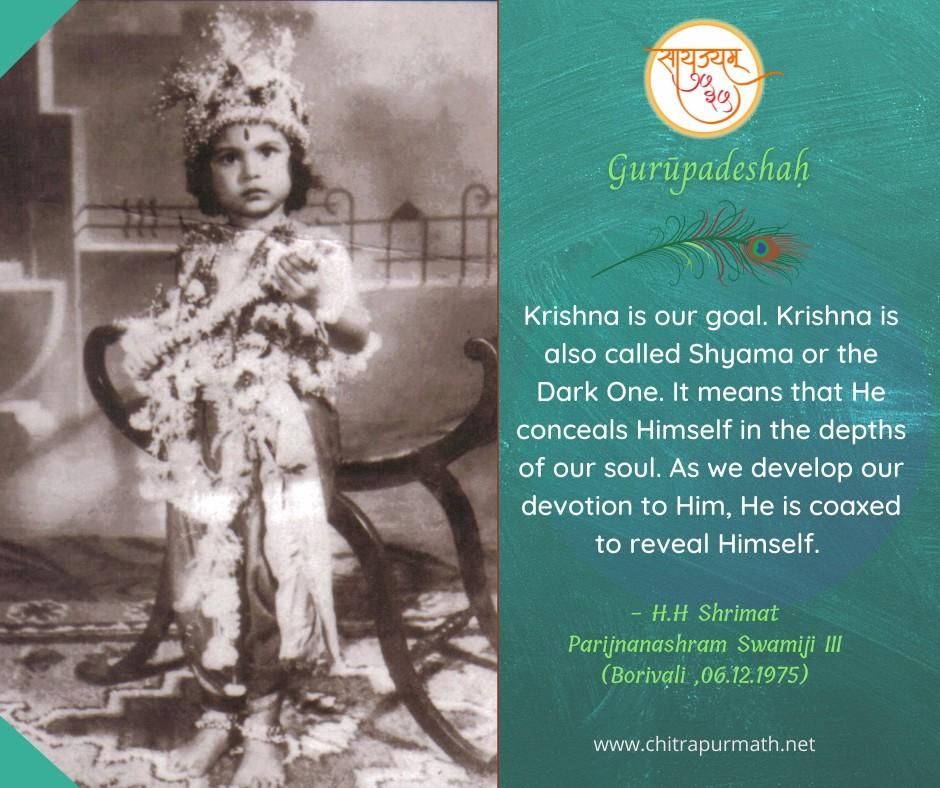
When Smt. Shāntābāī was expecting, she was rather apprehensive, especially due to the frequent visions of a Nāga in her dreams. She sought her father-in-law's advice. He was overjoyed and explained that these indications were harbingers of the advent of a ‘Yogīpurus͟ha’. Smt. Shāntābāī was reassured and blessed with the vision of a huge golden-hued, seven-hooded serpent, at the time of birth of the baby.
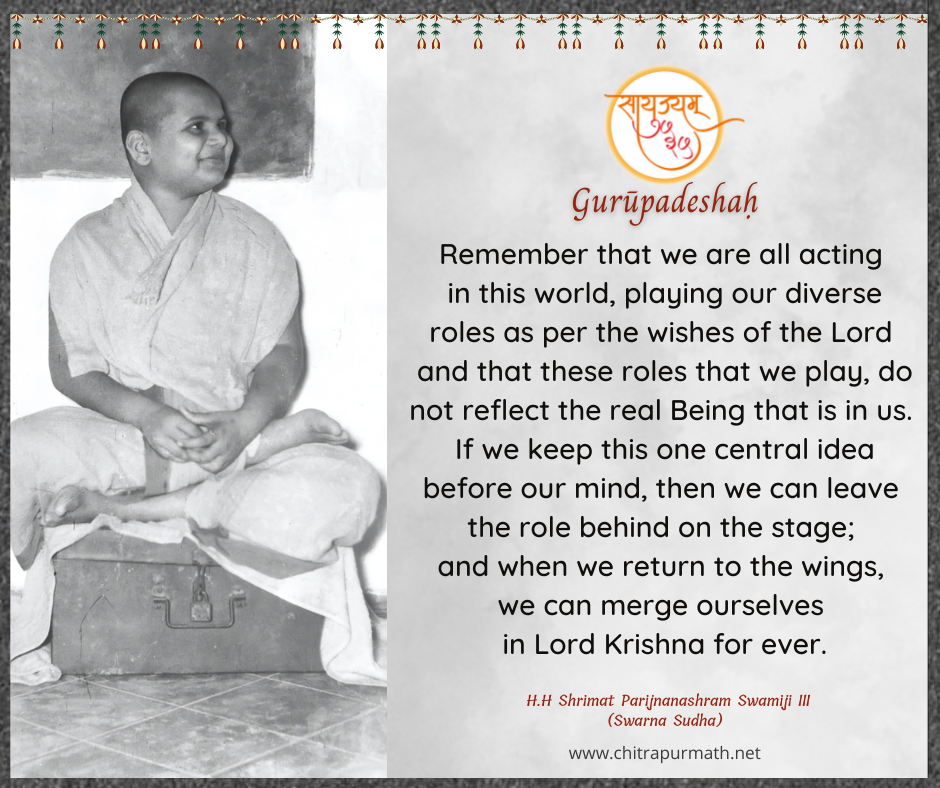
Growing up in the divya (godly) environs of Shrī Chitrāpur Mat͟h Shirālī, even as a toddler, little Ravīndra started going to the Mat͟h daily, especially to take Tīrtha from H.H. Shrīmad Ānandāshram Swāmījī.
Whenever Shrī Shaṅkaranārāyaṇ mām took him there, H.H. Swāmījī with a loving, witty smile would say: “होडी पोट्ली आनि सानीपोट्ली आयलीं ! (“Hoḍī poṭlī āni sānī poṭlī āyalī̇!!" - The bigger bundle and the smaller one have arrived!)
After the birth of little Ravīndra’s younger brother Shashī, H.H. Swāmījī would often say: “आतं होडी पोट्ली, सान पोट्ली आनि चिरपुट्ली आयलीं. (“Ātȧ hoḍī poṭlī, sān poṭlī ani chirpuṭlī āyalī̇”- Now the bigger bundle, smaller bundle and the tiny packet have come!)
At dawn, lovable, chubby, four-year-old, Ravīndra would offer a mogrā mālā (garland) at the Hoḍi Samādhi followed by Dhūl̃abheṭ. He would offer obeisance and naivedya (food offerings) to H.H. Shrīmad Ānandāshram Swāmījī and wait outside the chambers, steadfastly refusing to eat till H.H. Swāmījī had accepted the offering. Such was His self-control and bhakti bhāva, so consumed was He with His devotion to His Guru, that He would break His fast only with prasāda, no matter how late it was.
He would attend the Nitya-Niyama (daily pūjā-s and observances) and bhajana-s with gusto and participate in whatever way He could. He never missed the Dīpanamaskāra in the evening. He would offer a flower and tulasī mālā to H.H. Shrīmad Ānandāshram Swāmījī and wear it thereafter as prasāda. Upon reaching home, He would tell His grandfather Vedamūrti Laks͟hmaṇa Shukla, to wash His feet and offer pādapūjā just as it was offered to H.H. Shrīmad Ānandāshram Swāmījī. Little did they know that in the near future, the entire samāja would seek the privilege of offering this very sevā.
At Dīpanamaskāra, lighting the lamp and invoking the Guruparamparā, paying obeisance and seeking Their Blessings sets aflame all negativity and illuminates the Gurutattva within the hṛdaya-kamala. It leads to the Anugraha of the Guruparamparā and a flash of insight. This spark was so strong in little Ravīndra that any worldliness within Him gradually fell away giving way to focussed vairagya. He was drawn closer to H.H. Shrīmad Ānandāshram Swāmījī.
The Rāmāyaṇa, Mahābhārata, Shrī Guruparamparā Charitra, Purāṇa-s and other sacred scriptures were read every evening in the Mat͟h by the bhaṭ mām-s, after all the rituals were completed. Little Ravīndra loved attending such programmes and learnt many bhajana-s, shloka-s and stotra-s too. Whenever H.H. Shrimad Ānandāshram Swāmījī attended, He would lovingly admonish Ravīndra for staying up late and urge Him to go home to sleep. Little Ravīndra would reply with “No! No! It's not my bedtime yet. I must listen to the sacred stories before retiring for the day.” And thus, the bond between H.H. Swāmījī and adorable little Ravīndra grew stronger every day.
At the age of about five years, little Ravīndra had to leave behind His beloved grandparents (who continued to live near the Mat͟h in Shirālī) and move to Vākolā, Mumbaī with His parents.
When He was about eight years old, Kumār Ravīndra’s mūñjī (thread ceremony) was conducted in Shirālī. All the grown-ups recommended that the tonsure ceremony should be symbolic instead of shaving the baṭu’s head. Kumār Ravīndra would have none of that! He insisted that the ceremony should be conducted as per the shāstra-s. He calmly said, “My hair will grow back over time. Just because some children may pull my leg, should I not uphold my Dharma? How else can I offer abhis͟heka to Shrī Bhavānīshaṅkar Deva?”
At the time of the thread ceremony, H.H. Shrīmad Ānandāshram Swāmījī was at Mallāpur, but He came to Shirālī especially to offer the baṭu bhiks͟hā and Blessings. Since then, Kumār Ravīndra devotedly performed His Sandhyāvandanam without fail.
Once, when H.H. Shrīmad Ānandāshram Swāmījī was visiting Māṭuṅgā, Mumbaī, Kumār Ravīndra was overjoyed. Every day, as soon as He returned from school, He would rush to H.H. Swāmījī 's camp and fall at His feet. In the Shrīmad Bhagawadgītā recitation competition on Gītā Jayantī, He memorised the entire Chapter 12 in just six days and gave an accomplished performance to come first, much to the ānanda (satisfaction) of His beloved Swāmījī.
Kumār Ravīndra excelled in academics, sports and music. He was popular with the teachers and children alike. He was growing up to be witty, humorous and a little boisterous as boys are inclined to be. Sometimes, exasperated by His pranks His mother would ask Him to beg forgiveness for His naughtiness by falling at the parents’ feet. But, Kumār Ravīndra would refuse saying, “Never! I shall only fall at the Feet of H.H. Shrīmad Ānandāshram Swāmījī.”
When it was time for H.H. Shrīmad Ānandāshram Swāmījī to accept a shis͟hya, He was happy with Kumār Ravīndra being selected for that honour. Learned astrologers had read the horoscope which indicated a high level of vairāgya. Though initially apprehensive at the responsibility that her son would have to carry, Smt. Shāntābāī consented after she had a vision of Shrī Bhavānīshaṅkar Deva blessing her son with the abhaya hasta mudrā.
In the meantime, His mother, vexed with His mischievousness, would often scold Kumār Ravīndra saying, “You are going to become the Shis͟hya Swāmījī and Mat͟hādhipati later. You must develop discipline and calmness.”
To which Kumār Ravīndra’s playful rejoinder was, “Shrī Kṛs͟hṇa was naughty too. So, He asked His mother Yashodā to keep a Saṅkas͟hṭī vrata (fast) for His welfare. Perhaps you should do so too.” Thereafter, His mother observed this vrata for Him without fail.
On 1st March 1959, with the Grace of Shrī Bhavānīshaṅkar Deva, Kumār Ravīndra was ordained as H.H. Shrīmat Parijñānāshram (III) Shis͟hya Swāmījī in a grand ceremony joyously attended by over 10,000 sādhaka-s, at Mumbaī. H.H. Shrīmad Ānandāshram Swāmījī Blessed Him with the sacred Upadesha.
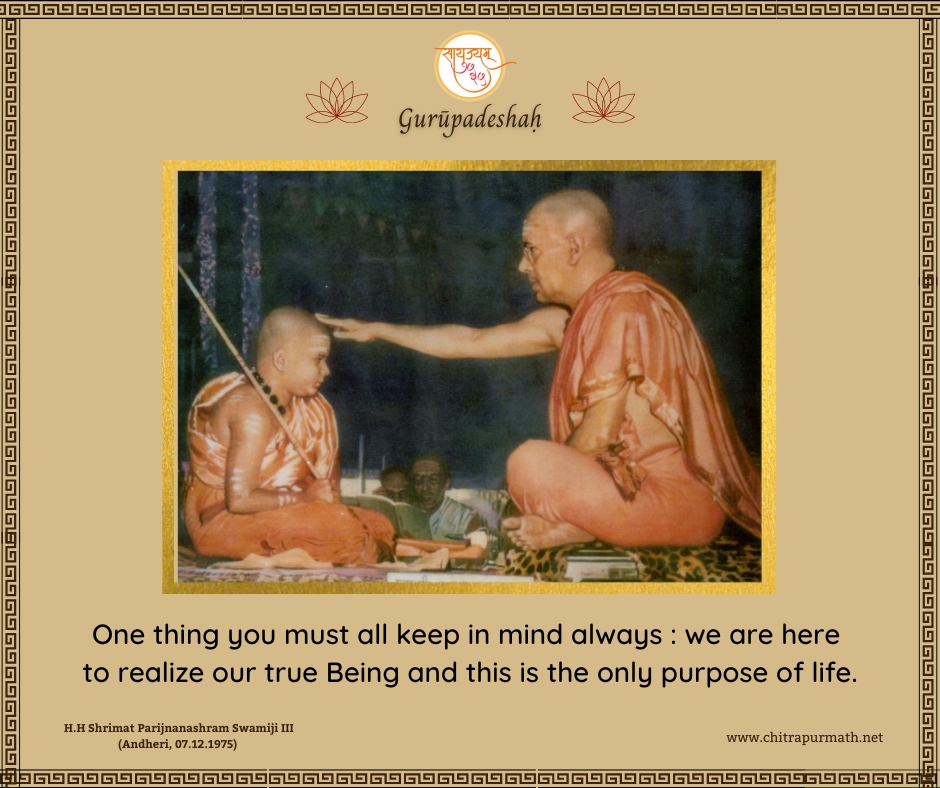
The divine Guru-Shis͟hya bond of mutual love and respect was above and beyond limited laukika (worldly) understanding. H.H. Shrīmad Ānandāshram Swāmījī Himself took charge of the Shis͟hya’s education. However, beset with Mat͟h affairs and the responsibilities of a Mat͟hādhipati, H.H. Swāmījī was forced to delegate a part of this to other Shāstrī-s who appeared sadly remiss in their duties. Negligence regarding health, food, welfare and administering extremely high doses of medicines had adverse long-term effects. Shis͟hya Swāmījī had to deal with diabetes, high blood pressure and other health complications from a tender age. However, uncomplaining that He was, Shis͟hya Swāmījī never raised His voice against any wrongdoing or torment. He continued with His studies and spiritual practices diligently. Even in those formative years, His words and actions (often laced with humour) demonstrated His vast ocean of Knowledge.
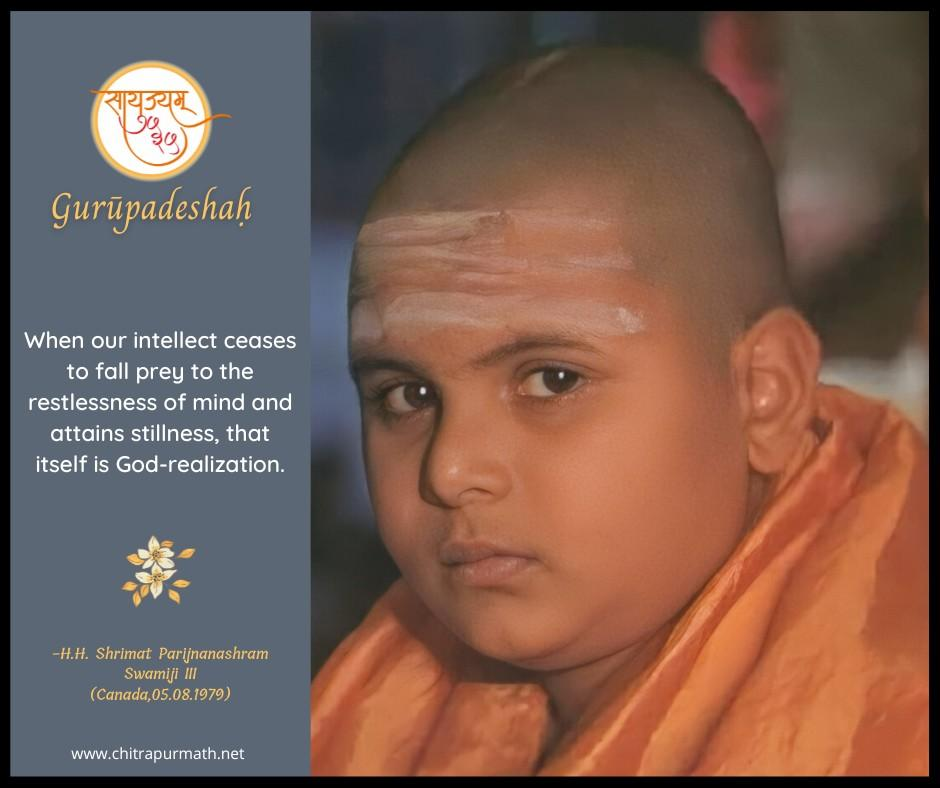
The Shivagaṅgā Sarovara is quite deep in the middle. So, one of the senior bhaṭ mām-s had put up a notice saying “पोहायला येत असेल त्यानीच तळ्यांत उडी घ्यावी।” (Jump into the Sarovara only if you know how to swim). Shis͟hya Swāmījī had humorously scribbled under it “तळ्यांत उडी मारल्याशिवाय पोहायला कसे येणार। ?” (How can one learn to swim without jumping into the pool?). Behind His playful words was a profound word ‘play’ with an underlying depth of meaning.
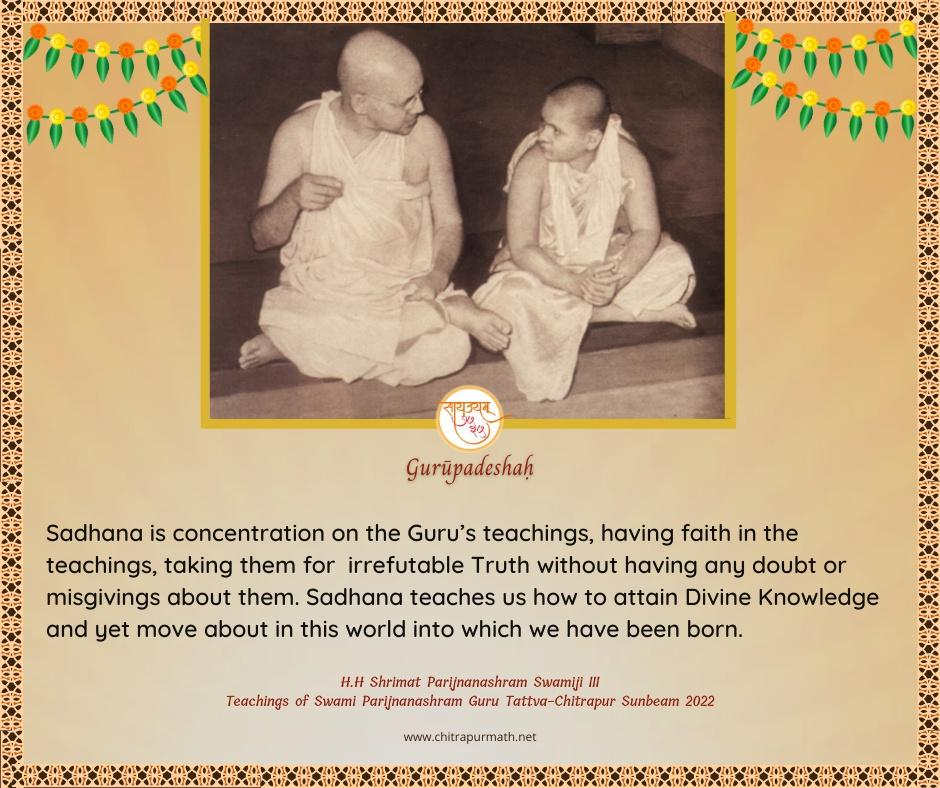
After leading the samāja for 50 glorious years, H.H. Shrīmad Ānandāshram Swāmījī’s health started failing. On Bhādrapada Shukla Tṛtīyā, He uttered the Praṇava Mantra ‘Oṁ’ and attained Mahāsamādhī at Beṅgal̃ūru Mat͟h. Shis͟hya Swāmījī was beside Himself with grief and anguish. After 12 days, H.H. Shrīmad Ānandāshram Swāmījī Blessed Shis͟hya Swāmījī with Sāks͟hāta Darshana. He explained certain duties and offered guidance. Above all, He reassured Shis͟hya Swāmījī that His presence would always be felt and Blessed Him with a small garland of Bhaṭkal̃ mogrā flowers which H.H. Shrīmat Parijñānāshram Swāmījī III always cherished.
H.H. Shrīmat Parijñānāshram Swāmījī III retreated to the Himālayas for seclusion. He returned in time for the consecration of H.H. Shrīmad Ānandāshram Swāmījī's Samādhi to fulfil His duty as per the shāstra-s. On 12th October 1967, on the auspicious occasion of Vijayādashamī, His Paṭṭābhis͟heka ceremony was performed by offering worship under a Shamī tree.
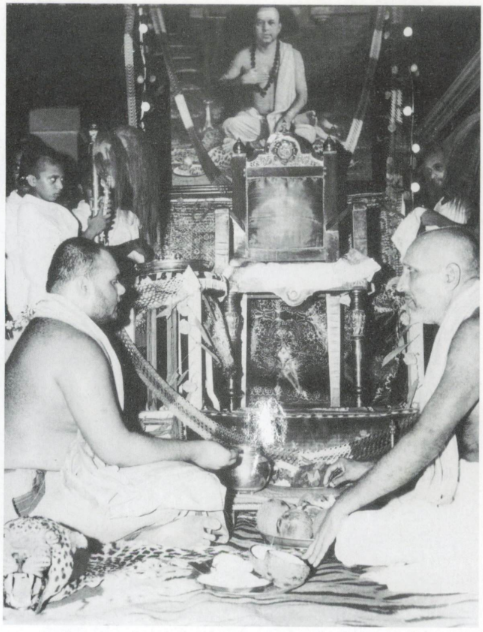
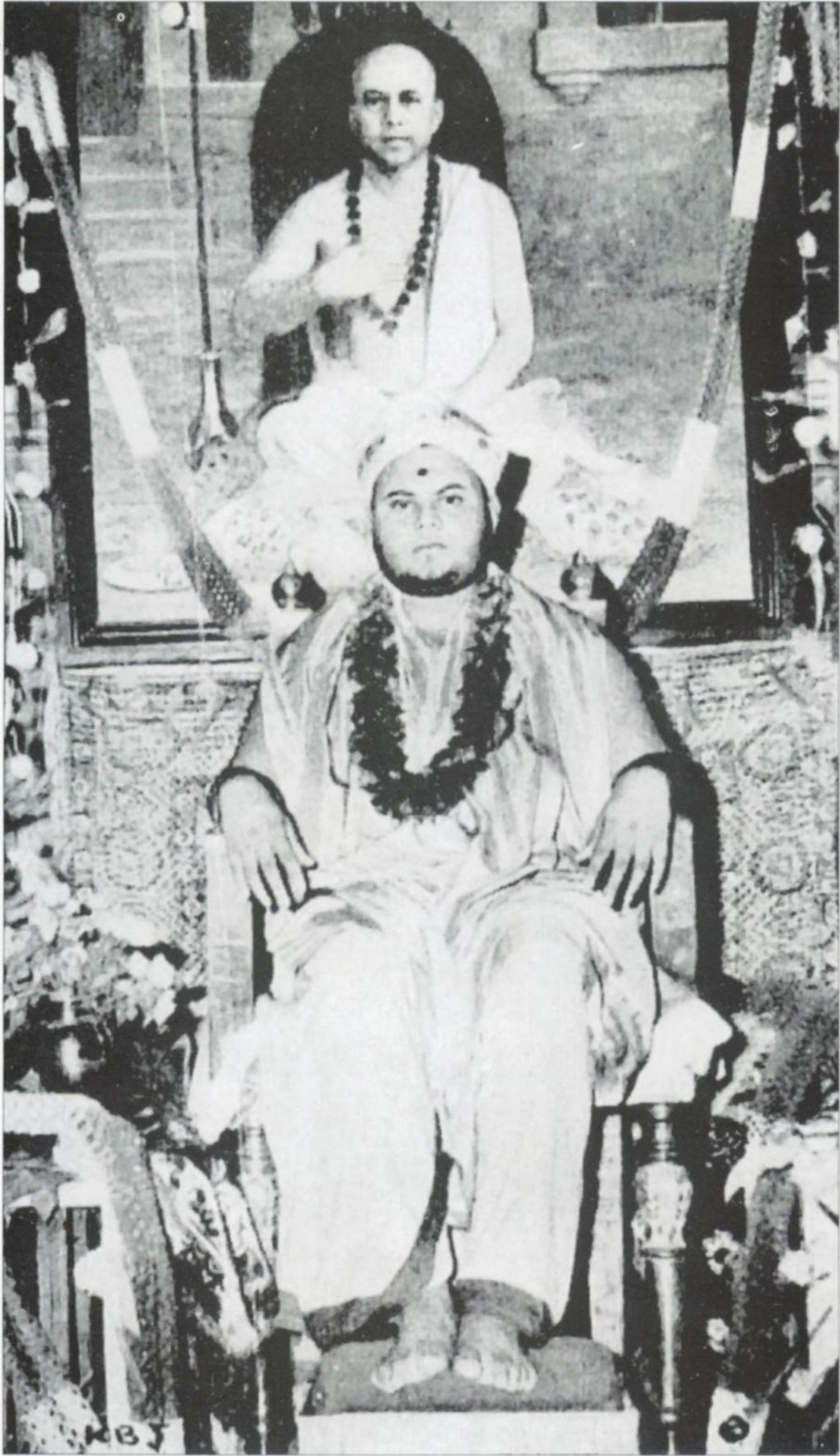
Paṭṭābhis͟heka ceremony
The silver throne was befittingly enhanced with the portrait of H.H. Shrīmad Ānandāshram Swāmījī placed above. Bowing down thrice with His Daṇḍa, H.H. Shrīmat Parijñānāshram Swāmījī III adorned the throne, taking the Sūtra-s of Mat͟hādhipatya in His Divine Hands.
Shis͟hya Swāmījī had now become Guru Swāmījī - the 10th Mat͟hādhipati of the Shrī Chitrāpur Mat͟h Guruparamparā
Oṁ Namaḥ Pārvatī Pataye Hara Hara Mahādeva!
Samarpaṇam
Shrī Gurucharaṇāravindārpaṇamastu
A Website Committee presentation for the Parijñānalaharī Mahotsavaḥ,
(15 June 2026 to 12 October 2027)
(Written by Smt. Chandrimā Kalbāg, sourced from the Sunbeam archives, Swarna Smruti, Shrī Guruparamparā Charitra (Koṅkaṇī), with research assistance from ChitrapurGPT and inputs from Shrī Chaitanya Gulvāḍy, Shrī Kris͟hṇānand Maṅkīkar, Smt. Shailajā Gāṅguly)
Explore : Shloka 1 -https://www.chitrapurmath.net/news/default/story?id=337
Shloka 2 - https://www.chitrapurmath.net/news/default/story?id=341