
The Shrī Chitrāpur Mat͟h Calendar: Time, Tithi-s, and Traditions
(Understanding the Shrī Chitrāpur Mat͟h Calendar: Part II)
Authored by – Smt. Chandrimā Kalbāg, with inputs from Shrī Chaitanya Gulvāḍy and Shrī Kris͟hṇānand Maṅkīkar, research inputs from Shrī Chitrāpur Sunbeam archives
The Hindū calendar or Pañchāṅga has been used in India since Vedic times. Though the Gregorian calendar is used in daily life, the pañchāṅga is still used to establish dates for Hindū religious observances and festivals. Ancient India, though historically an agrarian economy, had considerable trade and commerce with other countries. In those times, the pañchāṅga was relevant not only for forecasting religious events, but also to predict ideal times for sowing, reaping, trade and travel. Over time, different regions in India developed their own variations of the calendar or pañchāṅga.
The pañchāṅga evolved over centuries through keen observation, scientific analysis and mathematical refinement by our wise ṛs͟hi-s. The entire universe is in constant motion, with stars, planets, moons, comets and meteors hurtling through space at incredible speed. Our learned ṛs͟hi-s of ancient India for practical purposes, adopted a geo-centric model in which the skies were mapped in relation to the Earth. The Earth was considered to be the point of reference, while the position of the stars and the changing constellations were attributed to their apparent movement.
Based on the astronomical observations and the apparent movement of the Sun, Moon and stars, the changing seasons and passing days were mapped using nine measures of time (māna): Brāhma māna, Divya māna, Pitṛya māna, Prājāpatya māna, Guror māna, Saura māna (solar ), Sāvana māna (solar day), Chandra māna (lunar), and Nāks͟hatra māna (astronomical). (Only the last four are currently in use.)
The Sauramāna vars͟ha or Solar year, is the time taken by the Sun to apparently orbit the Earth once, passing through 12 Zodiac constellations and returning to the starting point when the Sun is in opposition to Chitrā Naks͟hatra, every 365.24 days. (In the Gregorian calendar, the discrepancy is resolved through intercalation or adding an extra day to February every four years.)
Chandramāna vars͟ha or the Lunar year, is based upon the 12 Lunar months. A period between one Pūrṇimā (full moon) and the next, or between one Amāvāsyā (new moon) and the following one, (each comprising of one complete Shukla Paks͟ha and Kṛs͟hṇa Paks͟ha), is considered to be a lunar month. Since the Moon takes about 29.5 days to make one complete orbit around the Earth, the Chandramāna (lunar) year is approximately 354 days. A variance of about 10-11 days occurs between a lunar and solar year. To compensate for this difference, an additional (intercalary) month or Adhika Māsa is added after every 32-33 months. (Further details given below)
The essential elements of the calendar issued by Shrī Chitrāpur Mat͟h and how to read it is described below.
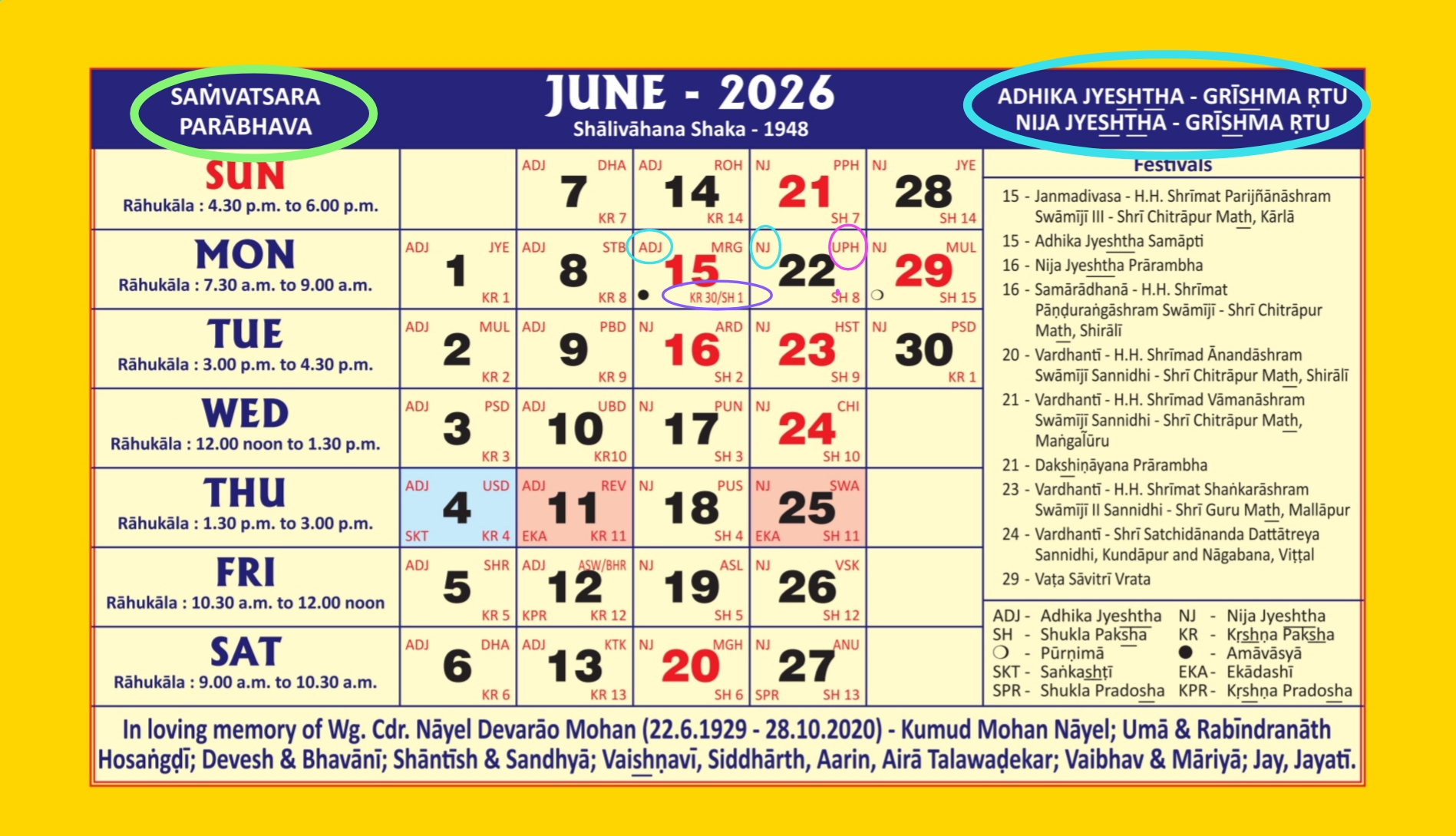
Saṁvatsara
In our calendar system, each year or Saṁvatsara has a name following a 60-year cycle. Each name has a special meaning and significance, often translating into its characteristics, starting with Prabhava (beginning) and ending with K͟shaya (end), after which the cycle is repeated. The 60-year cycle is associated with the movement and relative positions of Jupiter and Saturn, which return to the same position cyclically, every 60 years.
The year begins with Yugādi on Chaitra Shukla Pratipadā. The Vars͟ha phala of the Saṁvatsara and what the year ahead is likely to hold, are elaborated during the pañchāṅga vāchana by a priest or community elder. At Shrī Chitrāpur Mat͟h, we follow the Chandramāna system. The name of the Saṁvatsara is given on the top left-hand corner of our Mat͟h calendar. (Currently, we are in the Parābhava nāma Saṁvatsara)
Ayana
Each year is divided into two parts or Ayana-s: Uttarāyaṇa and Daks͟hiṇāyana. Caused by the tilt in the Earth’s axis, these two phases trace the Sun’s apparent northward and southward movement respectively, relative to the celestial equator. In the Northern Hemisphere, Uttarāyaṇa begins the day after the Winter Solstice or Makara Saṅkrānti, and Daks͟hiṇāyana commences the day after the Summer Solstice or Karka Saṅkrānti.
Ṛtu
The year is further divided into six seasons of two months each, given at the top right-hand corner of our Mat͟h calendar: Vasanta (spring), Grīs͟hma (summer), Vars͟hā (rains), Sharada (autumn), Hemanta (winter) and Shishira (cool)
Māsa
A Saṁvatsara consists of 12 lunar months. Each month consists of a full cycle of the Moon's phases, i.e., one Shukla Paks͟ha and one Kṛs͟hṇa Paks͟ha. The name of the month is given along with the corresponding ṛtu on the top righthand side in our Mat͟h calendar. Since the month ends with Amāvāsyā, it is called Amāvāsyānta or Amānta Māsa. In some regions, Pūrṇimānta Māsa is followed, where the month ends with Pūrṇimā.
The 12 months in our Mat͟h calendar are: Chaitra, Vaishākha, Jyes͟ht͟ha, Ās͟hād͟ha, Shrāvaṇa, Bhādrapada, Āshwija, Kārtika, Mārgashīrs͟ha, Pus͟hya, Māgha and Phālguna.
Paks͟ha and Tithi
Each month is divided into two paks͟ha-s: Shukla Paks͟ha (waxing moon - starting the day after new moon and ending with Pūrṇimā) and Kṛs͟hṇa Paks͟ha (waning moon - starting the day after full moon and ending on Amāvāsyā). Each Paks͟ha is about a fortnight long. Each phase of the moon is called a tithi. Since the Earth and Moon are in constant motion in their orbits and around their axes, there are times when the tithi lasts longer or shorter depending upon their respective positions. So, a tithi is not the same as a solar ‘day’ or calendar ‘date’, but ranges from 22 to 26 hours. Thus, the tithi can change during the day or extend into the next solar day or divasa. The Paks͟ha is denoted as ‘SH’(Shukla) or ‘KR' (Kṛs͟hṇa) along with the tithi in the bottom right corner of the date cell in the Mat͟h calendar. The first tithi of either Paks͟ha is called Pratipadā, followed by Dwitīyā , Tṛtīyā and so on, upto Chaturdashī. The 15th tithi of the Shukla Paks͟ha is the full moon i.e. Pūrṇimā and the 15th tithi of the Kṛs͟hṇa Paks͟ha is the new moon i.e. Amāvāsyā.
Divasa or Vāsara
A solar day is named after the Sun, Moon and the first five planets:
● Ravivāsara (Sunday - Sun)
● Somavāsara (Monday - Moon)
● Maṅgalavāsara (Tuesday - Mars)
● Budhavāsara (Wednesday - Mercury)
● Guruvāsara (Thursday - Jupiter)
● Shukravāsara (Friday - Venus)
● Shanivāsara (Saturday - Saturn)
Pañchāṅga
It is used to determine festival dates, eclipses and religious observances. The five (pañcha) limbs (aṅga-s) of the Hindū calendar (pañchāṅga) consist of:
1. Lunar day (tithi)
2. Half-day (karaṇa)
3. Constellation (naks͟hatra)
4. Angles of Sun and Moon (yoga)
5. Solar day (divasa or vāsara)
Rāshi
In the geo-centric perception, the ecliptic of the visible sky is divided into 12 Rāshi-s (zodiac signs), each in an arc of 30° (i.e. 360° / 30° = 12) starting with Revatī. A sauramāsa (solar month) is the time taken by the Sun to traverse a rāshi, and is also named after it. The moment in time when the Sun transits from one rāshi and enters the next is known as a saṅkramaṇa or saṅkrānti.
Naks͟hatra-s
The Moon's position at birth determines one's naks͟hatra depending upon the position of the stars or star groups. The naks͟hatra is mentioned in the upper right corner of the date cell in our Mat͟h calendar.
Muhūrta-s
There are 30 muhūrta-s per day of about 48 minutes each. Planetary/ naks͟hatra positions make certain muhūrta-s favourable/ unfavourable for specific activities.
Adhika Māsa (Purus͟hottama Māsa)
If a lunar month elapses without a saṅkrānti and the Sun remains within the same rāshi, then it is named according to the upcoming māsa, along with the epithet adhika (extra).
Since the lunar year comprises about 354 days and the solar year is 365 days long, the lunar year falls short by about 11 days each year. To offset this difference, an intercalary month called Adhika Māsa is added every 2 1⁄2 to 3 years.
For example, if the Sun does not transit from Vṛs͟habha (Taurus) into Mithuna (Gemini), then the month without transit is labelled Adhika Jyes͟ht͟ha Māsa. After Adhika Jyes͟ht͟ha Māsa ends (typically on Amāvāsyā), the regular (Nija) Jyes͟ht͟ha Māsa begins.
Ks͟haya Māsa
A month with two saṅkrānti-s is known as a Ks͟haya Māsa. This is an extremely rare occurrence, usually once in 141 years or sometimes once in 19 years. In a Ks͟haya Māsa year, within a period of 12 months (though not necessarily in the same Saṁvatsara) two Adhika Māsa-s are bound to occur. One preceding the Ks͟haya Māsa is prefixed with Saṁsarpa, as in Saṁsarpa Kārtika Māsa. The succeeding month is suffixed with ‘bhayātmaka’, like Ks͟haya Kārtika - Mārgashīrs͟hobhayātmaka Māsa. This is not considered to be an auspicious month. Maṅgala kārya-s like Upanayanam, weddings and other similar events are avoided. Increased sadhana-s and self-discipline during this period are advisable.
The occurrence of Adhika māsa and Ks͟haya māsa synchronise and maintain the balance between the Solar and Lunar calendars.
The greatest lesson that one can learn from the phases of the moon are that good and bad times keep changing. Our ṛshis have said ‘नष्टा वेला या गता सा गतैव’ (time wasted is gone forever and does not return). Therefore, every day of the year is an opportunity for us to enhance our Ādhyātmika (spiritual) and Vyavahārika (mundane) karma-s. Though some periods within the year are considered more suitable for certain types of events and ceremonies in Vyavahārika life, every day is meant for self-improvement, with the Guidance and Blessings of our Guru and Guruparamparā.
Explore : Adhika Masa- the Thirteenth Month: A Sacred Opportunity for
Spiritual Elevation: https://www.chitrapurmath.net/news/default/story?id=329