
Naga Panchami
(Authored by – Smt. Chandrimā Kalbāg, with inputs from Ved. Shrī Nāgesh Hal̃dīpur Bhaṭ, Shrī Chaitanya Gulvāḍy and Shrī Kris͟hṇānand Maṅkīkar, based on research from the Sunbeam Archives and ChitrāpurGPT)
The Gaṅgā flowed deep and swift. The undercurrents belied her apparent stillness. On the south bank, facing north, sat the most powerful man on Earth, on a Kusha grass mat. The setting sun had turned the sky into molten gold, the Gaṅgā waters shimmered and danced, the tree under which he sat cast a dappled shade, but he was oblivious to all of it. For the past few days, he had been blessed with the august presence of great ṛs͟hi-s like Vasis͟ht͟ha, Vishwāmitra and Shuka. He had prostrated before them offering obeisance, honoured them, sought their guidance and ādhyātmika knowledge, which was later compiled into Shrīmad Bhāgavatam. He had been the just and mighty ruler of Bhāratavars͟ha, but now he had handed over the kingdom to his son and cut all ties with worldliness. Completely detached, he was absorbed in single-minded meditation upon the Lotus Feet of Bhagawān Mahāvis͟hṇu reclining on Ādishes͟ha Nāga. He was unaware of Ādishes͟ha's brother, Taks͟haka slithering towards him with his beady eyes and poisonous fangs. Taks͟haka had cunningly lured away all those who knew how to treat snake venom before he sank his fangs into the erstwhile king. As the venom spread through his body, Parīks͟hit felt only release from his mortal coil. He prayed for forgiveness for a sin he had once impulsively committed.
In his final moments, Parīks͟hit, the able erstwhile King of Hastināpura, the grandson of Arjuna protected by Bhagawān Kṛs͟hṇa, recalled with regret his one misdemeanour. During an expedition, travel weary, hungry and thirsty, he had come upon the hut of a sādhu, who was in samādhi (deep meditation) and unaware of the visitor. In the grip of a sudden flash of anger due to weariness and the perceived insult of being ignored, Parīks͟hit had draped the skin of a dead snake around the neck of the sādhu, to see if his Samādhi was a pretence. The sādhu’s son Shṛṅgī, enraged at the insult, had cursed the king, "You will be bitten by Taks͟haka and die within seven days!" Parīks͟hit wanted to atone for his sin before the fateful words came true.
After Parīks͟hit, his son Janamejaya became an able ruler, but was inconsolable at his father's death and wanted revenge by killing Taks͟haka. So, he conducted the Sarpa Satra Yajña. The incantation of powerful mantra-s drew snakes from all over, causing them to fall into the sacrificial fire as oblation. Taks͟haka, the Nāga King, sought refuge with Indra, the King of the Deva-s. Since the powerful mantra-s were inexorably drawing the entire Indra-loka towards the sacrificial fire, they appealed to Taks͟haka’s sister Jaratkāru (later known as Manasā), who sent her son ṛs͟hi Āstīka for deliverance.
Āstīka ṛs͟hi, with his knowledge of the Shāstra-s, prevailed upon King Janamejaya to stop the yajña and spare the snakes. He explained that Taks͟haka was only an instrument or apparent cause of death for Parīks͟hit, as in fact all beings born are destined to die, due to some reason or other. One should not get entangled in a web of emotions and commit errors emanating from jealousy, greed, lust, revenge and arrogance, as they generate negative karmaphala - the consequences of actions that bind one to the cycle of birth and death. Realising the wisdom of these words, Janamejaya concluded the Sarpa Satra on Shrāvaṇa Shukla Pañchamī, which came to be known as Nāga Pañchamī.
But who was ṛs͟hi Āstīka? Amongst the many wives of Kashyapa Muni were two sisters Kadrū and Vinatā, daughters of Daks͟ha. They were extremely jealous of each other. When it came to progeny, Kashyapa Muni granted them a boon each. Kadrū became the mother of a thousand snakes while Vinatā asked for two sons who would destroy them. Eventually Kadrū's offspring became numerous and powerful, indiscriminately biting and poisoning every life-form they chanced upon. Vinatā became the mother of Aruṇa (the charioteer of Sūrya Deva) and Garuḍa (the vāhana of Bhagawān Vis͟hṇu).
In this hate-filled environment, poison was not just metaphoric. Amongst Kadrū's progeny, the eldest offspring, Shes͟ha, became disenchanted with the toxic environment and went away in search of Higher Knowledge. Under the guidance of Brahmadeva, he came to uphold Bhūdevī upon his hood. Pleased with him, Bhūdevī bestowed the epithet of ‘Ādi’ on him and thus, he became Ādi-Shes͟ha. It is said that Bhagawān Vis͟hṇu rests upon the coiled Ādi-Shes͟ha in the Ks͟hīra-sāgara.
The scheming Kadrū had lured Vinatā into a bet. Kadrū asked Vinatā if the tail of the lustrously white celestial horse Uchchaiḥshravas was black or white. Vinata replied that it was white. Kadrū insisted that the tail of Uchchaiḥshravas was actually black, while Vinatā was sure that it was white. Kadrū deviously asked her sons to coil around the tail of the horse, to make it appear black. The snake children were shocked at Kadrū’s deceit and refused to do her bidding. Incensed, she cursed her own children to be destroyed by fire. Finally, the serpent children complied but it was too late to avert the curse. While the rest of the serpent siblings came up with impractical and sometimes obnoxious solutions, one of them had overheard Brahmadeva saying that only the evil snakes would be destroyed in the sacrificial fire. The others would be saved by Āstīka, the son of their sister Jaratkāru. She would marry a sādhu with the same name as hers. Vāsuki, the pragmatic one amongst them, ensured that the marriage took place, leading to the birth of Āstīka. Eventually Āstīka became a learned sage through tapashcharyā and the guidance of his Guru. Thus, though Shes͟ha, Vāsuki, Taks͟haka, Jaratkāru, the other snakes and their half siblings, Aruṇa and Garuḍa, were all in the same virulent atmosphere, some of them could break out of it through their efforts, determination and realisation.
In another instance, Vāsuki agreed to become the 'churning-rope' during Samudra Manthana, while Bhagawān Vis͟hṇu took the Kūrma Avatāra to act as a pivot, and Mount Mandāra became the churning stick. The Deva-s held the tail end while the Asura-s held Vāsuki’s head and pulled with all their might to churn the Ks͟hīra-sāgara (the Cosmic Ocean) in the quest for Amṛta. The process was so painful that Vāsuki spewed fire in the process.
Vāsuki adorns Bhagawān Mahādeva’s neck, symbolising Shiva’s control over ahaṅkāra (ego). In other symbolisms, the Kunḍalinī Shakti of Devī is depicted as a coiled snake at the Mūlādhāra chakra and Kārtika or Subrahmaṇya Deva is also associated with serpents. Thus, Nāga Pañchamī honours all the erstwhile venerable Nāga-s and sarpa-s. The festival also reminds us about the balance in nature. Serpents are considered to be the protectors of water bodies. They also symbolise fertility, the cycle of birth and death, the food chain and the harmony in Sṛs͟hṭi or Creation, throughout the Universe.
Most temples in India especially in Karnāṭaka and Kerala, notably those dedicated to Bhagawān Shiva, Bhagawān Vis͟hṇu, Devī and Subrahmaṇya Deva, have a Nāgālaya under the nearest Audumbara Vṛks͟ha. Kukke Subrahmaṇya Deva Temple in Karnāṭaka is a popular Nāga-Dos͟ha Parihāra pilgrimage centre. Shrīmath Anantheshwar Temple, Viṭṭal has a Nāgālaya too.
At Shrī Chitrāpur Mat͟h (Shirālī and Kārlā), Nāga Bimba-s have been installed in the Nāgālaya. Many family Nāga Bimba-s have also been placed here. Pūjā is offered every morning to all of them, but on Shrāvaṇa Shukla Pañchamī elaborate pūjā-s with vastra, yajñopavīta (jānve̐ or sacred thread), pus͟hpālaṅkāra, as͟hṭottarashata nāmāvali pūjā, phala naivedya and mahābhis͟heka are performed with Pavamāna Pārāyaṇa. Pavamāna is a collection of mantra-s in five adhyāya-s (chapters) from the Ṛg Veda, chanted especially on Nāga Pañchamī. Bhānap-s of the Kaushika Gotra don a new yajñopavīta (jānve̐) while casting off the old one on Nāga Pañchamī instead of Suttā Punnava (Shrāvaṇa Pūrṇīmā), on which Ṛg Vedika Upākarma Vrata is performed .
On Nāga Pañchamī, sādhaka-s perform abhis͟heka with milk and make offerings to propitiate Nāga devatā-s, especially to overcome dos͟ha-s seen in their horoscopes. Sarpa-s and nāga-s represent various aspects of nature, ranging from the sinister to the subtle or mystic. They reassure us that one can overcome one's negative nature or circumstances if one has the will to do so, leading to ādhyātmika upliftment, finally freeing one from the cycle of birth and death to attain Moks͟ha.
_(3).jpg) Nāgālaya at Shrī Chitrāpur Mat͟h (Shirālī)
Nāgālaya at Shrī Chitrāpur Mat͟h (Shirālī)
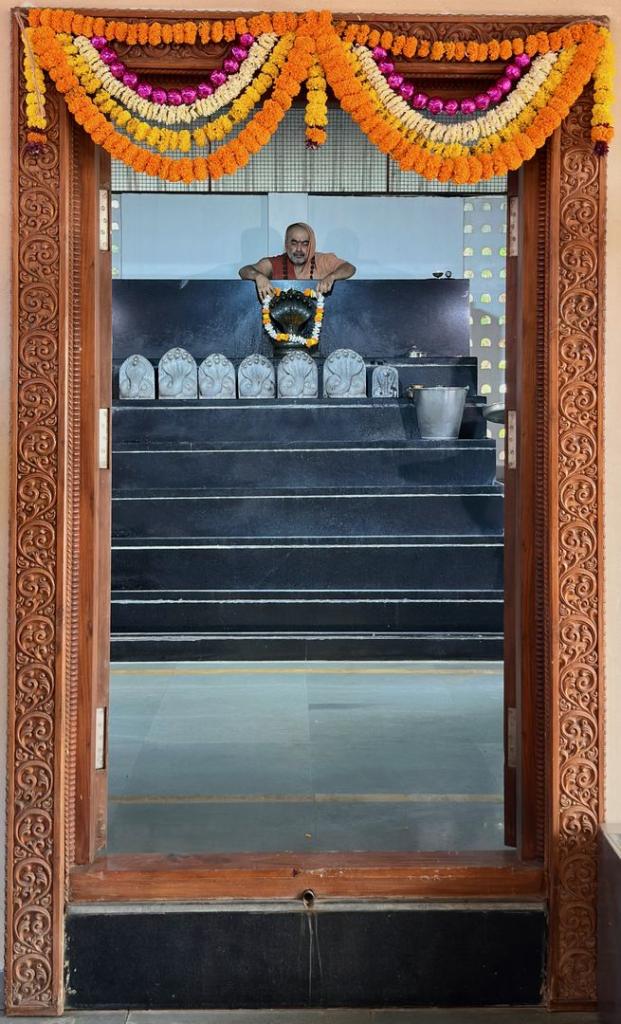 Nāgālaya at Kārlā
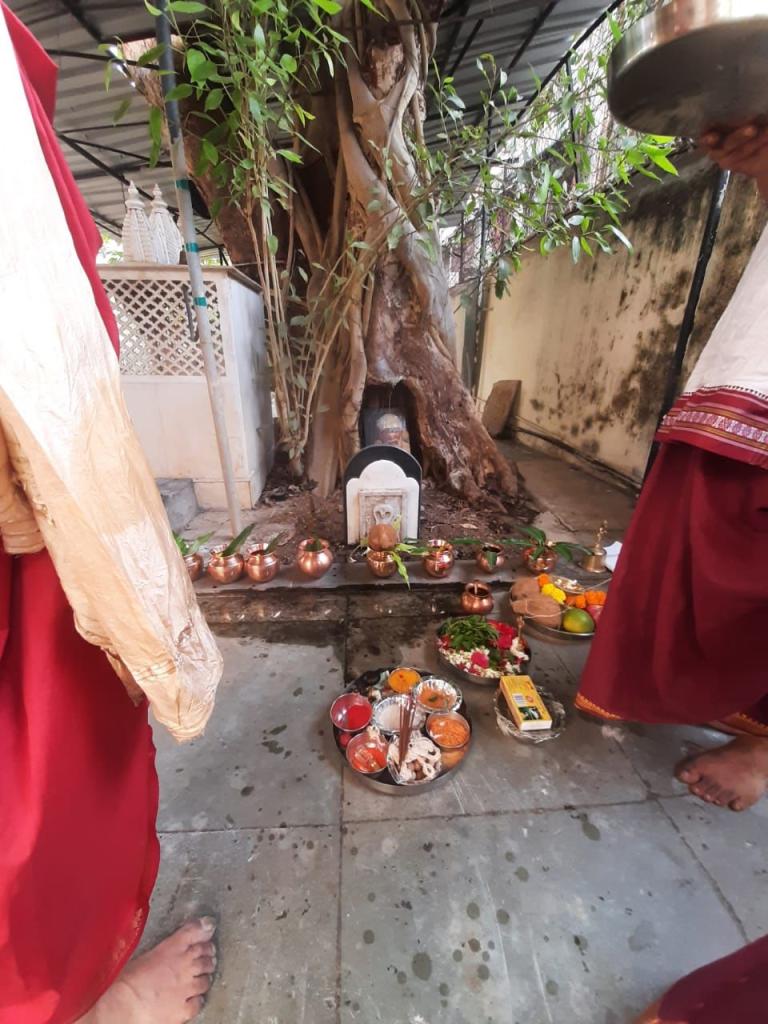 Nāga Katte
 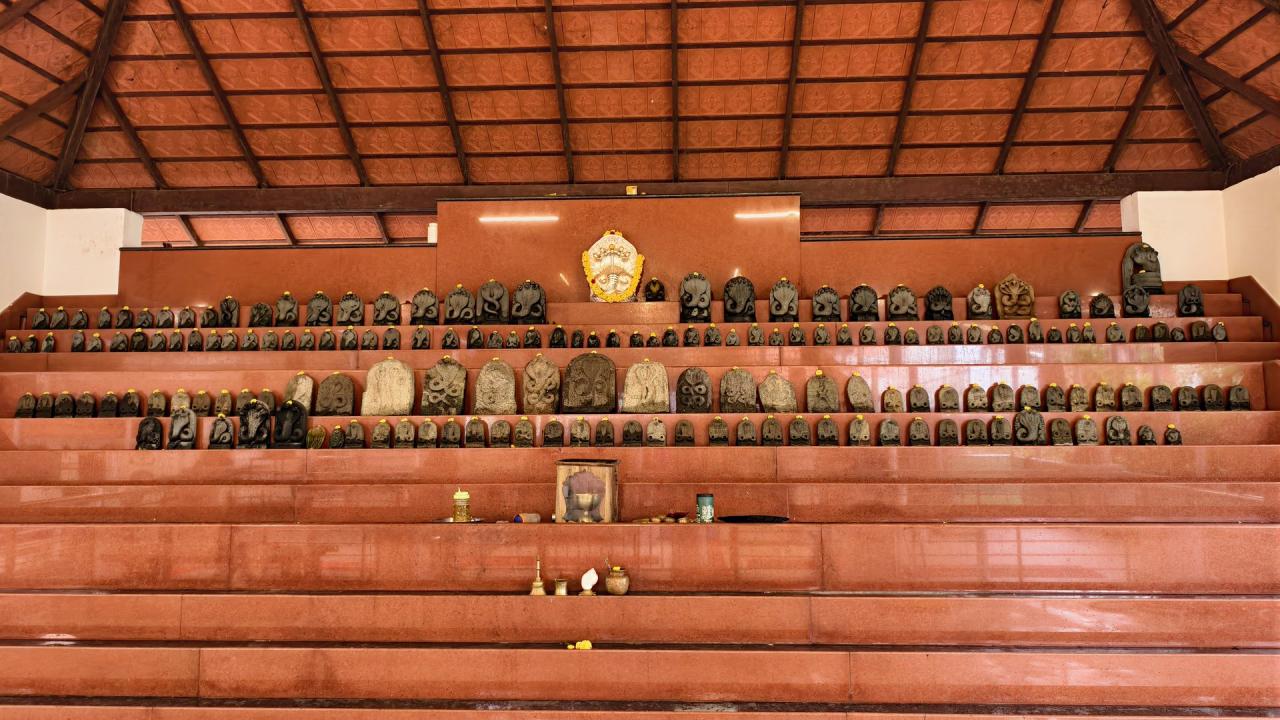 Nāgālaya at Shrīmath Anantheshwar Temple, Viṭṭal
(Picture courtesy Shrī Jaikishan Kaṇḍlur)