
Where the Flag Arises, Faith Awakens: The Dhwajastambha Tradition
(Written by Chandrimā Kalbāg, with inputs from Shrī Ved. Ul̃maṇ Gurubhaṭ, Shrī Nāgesh Hal̃dīpur Bhaṭ, Viṭṭal Vijaykumār Bhaṭ mām, Shrī Rājgopāl Bhaṭ mām, Smt. Geetā U. Nīlekaṇī, Shrī Kris͟hṇānanda Maṅkīkar, Shrī Shāntīsh Nāyel)
The tall majestic pillar or Dhwajastambha along with Rāmāñjaneya and Ks͟hetrapāla, in front of our Shrī Chitrāpur Mat͟͟h is a familiar sight which fills our hearts with love and pride for our Glorious Guruparamparā and our Revered Mat͟͟h.
The Dhwajastambha (Koḍī Khāmbŏ in Koṅkaṇī) is the sacred flag pole that proclaims the insignia of the Main deity installed within the temple or Mat͟͟h, and thus holds a special spiritual significance. It is also called the Garuḍastambha at Vis͟hṇu Pradhāna temples as Garuḍa the Vāhana of Vis͟hṇu is usually installed on top of the Stambha. It is located in prominent areas in front of the temple, like the Rājāṅgaṇa, usually at a specific distance from the Garbha guḍī, (the innermost sanctum sanctorum where the Main deity is installed) and is an essential component of temple architecture.
The Dhwajastambha comprises various components, each with its own significance. The top portion is called the Sahasrārapadma while the base is the Mūlādhāra and the section in between is the Meru Daṇḍa (spinal cord). Thus, it represents the path the Kunḍalinī takes as it rises within the human body. The Koḍī comprises of the Dhwaja, with a bell and a rope to hoist it. Shaktī pūjā is offered to the Dhwaja, which represents Agni, while Nāda pūjā is offered to the bell. During festivals, the Dhwajastambha is adorned with a variety of fruits, vegetables, flowers - especially bhingāru (supārī), mango and vaṭa leaves. After appropriate pūjā, archanā and other rituals prescribed by the shāstra-s, the flag is hoisted, while chanting Mantra-s awakening the Kunḍalinī Shakti in the Dhwajastambha. Combined with the Agni tattva in the Dhwaja, the respiration process is initiated. The rope represents air (Vāyu Tattva), while vaṭa and mango leaves signify the nostrils or Iḍā and Piṅgalā, (Nādī-s or nerve channels present in human body as per Āyurveda). Thus, the Dhwajastambha acquires Devatā -Chaitanya. The process is reversed during Dhwajāvarohaṇa (bringing down the Dhwaja at the end of the festival/event).
Significant events and festivals at the temple or Mat͟h are marked by Dhwajārohaṇa, hoisting pennants or designated flags on the Dhwajastambha after offering Āgamokta (as per Āgama-s) Pūjana. Āgama-s are ancient scriptures (Shāstra-s) which describe methods of offering Pūjana and following the other aspects of spiritual life by the householder, not covered in the Veda-s.
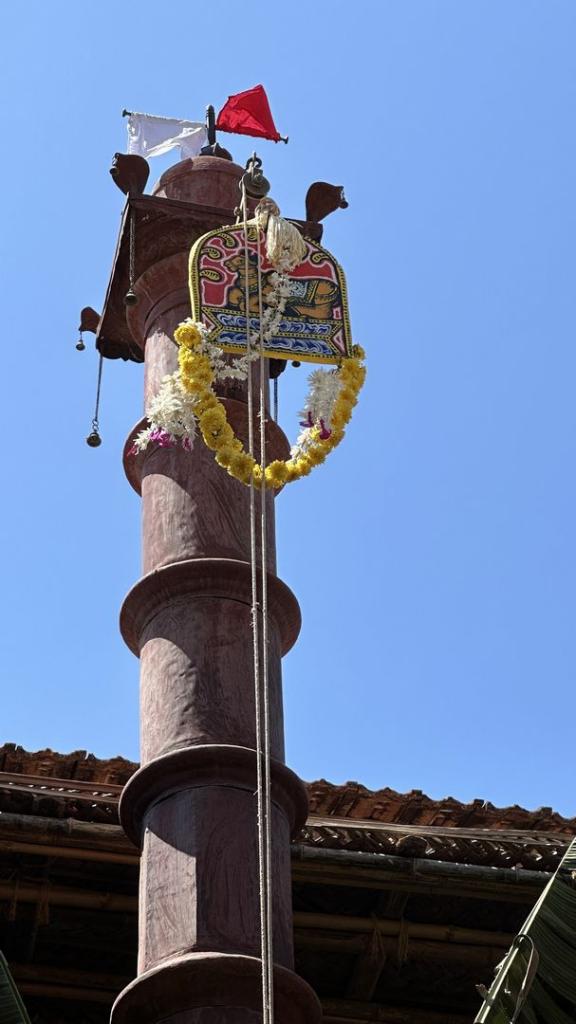
Dhwajastambha at Shrī Chitrāpur Mat͟h, Shirālī
The Rathotsava at Shrī Chitrāpur Mat͟h, Shirālī commences with Dhwajārohaṇa. It is concluded with Dhwajāvarohaṇa after the Avabhṛtotsava (purificatory bath), followed by Mahāpūjā, Maṅgalāratī, Sāmūhika Prārthanā, Aṅkur Prasāda Vitaraṇa. It is recommended that the devotees who attend the Rathotsava from Koḍī, participate in the Avabhṛta snāna (Vokkul̃ī or Okkul̃ī). The area around the Dhwajastambha is full of verve and colour as sādhaka-s gustily participate in Vokkul̃ī. Coloured water is liberally thrown on all the men, drenching them with the Bliss of Rathotsava and the Sānnidhya of our Ārādhya devatā, Shrī Bhavānīshaṅkar.
The Rathotsava at Shrī Chitrāpur Mat͟h, Shirālī was started by H.H. Shrīmat Kris͟hṇāshram Swāmījī in 1862, to fulfil the earnest desire of His Shis͟hya Swāmī, H.H. Shrīmat Pāṇḍuraṅgāshram Swāmījī, to attend a Rathotsava at Vyaṅkaṭāpura. The tradition continued under H.H. Shrīmat Pāṇḍuraṅgāshram Swāmījī, and then under the aegis of H.H. Shrīmad Ānandāshram Swāmījī for the next 77 years, upto 1939. During this period, the Dhwajastambha was raised and installed ceremoniously just before the Rathotsava, and removed after the Dhwajāvarohaṇa. The wooden Stambha used to be kept beside the Mat͟h building, supported by the stones alongside the walkway to the Bhojanālaya in the yester-years.
On one occasion, a small child asked H.H. Shrīmat Pāṇḍuraṅgāshram Swāmījī why such a big pole lifted by so many men was being pitted in the foreground. Swāmījī smilingly said that a big elephant would be coming the next day, so a big 'Khāmbŏ' would be needed to tie it. Uncannily, a rogue elephant escaped evading all attempts to catch it, and ran up to Shrī Chitrāpur Mat͟h where it was captured and tied to the 'Stambha'.
The Rathotsava at Shirālī was put on hold for about 34 years and reinstated in 1973 by H.H. Shrīmat Parijñānāshram Swāmījī III. By this time, the Koḍī Khāmbŏ (Dhwajastambha) was in a dilapidated state and needed replacement. The new Stambha was installed in the middle hall i.e. the earlier portico (opposite the present Devī Bhuvaneshwarī Sannidhi) with Āgamokta Vidhi-s in the august presence of H.H. Shrīmat Parijñānāshram Swāmījī. It would later be copper plated and placed in a permanent pīt͟ha adorned with a bronze Nandī at the shikhara.
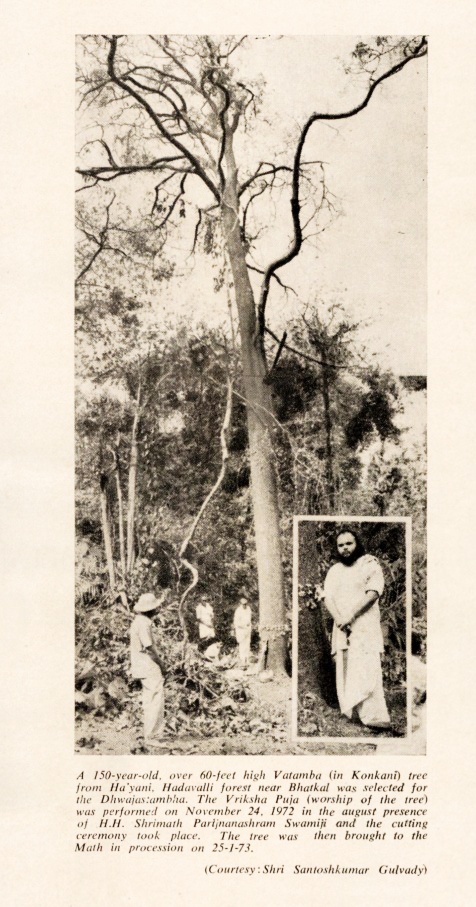
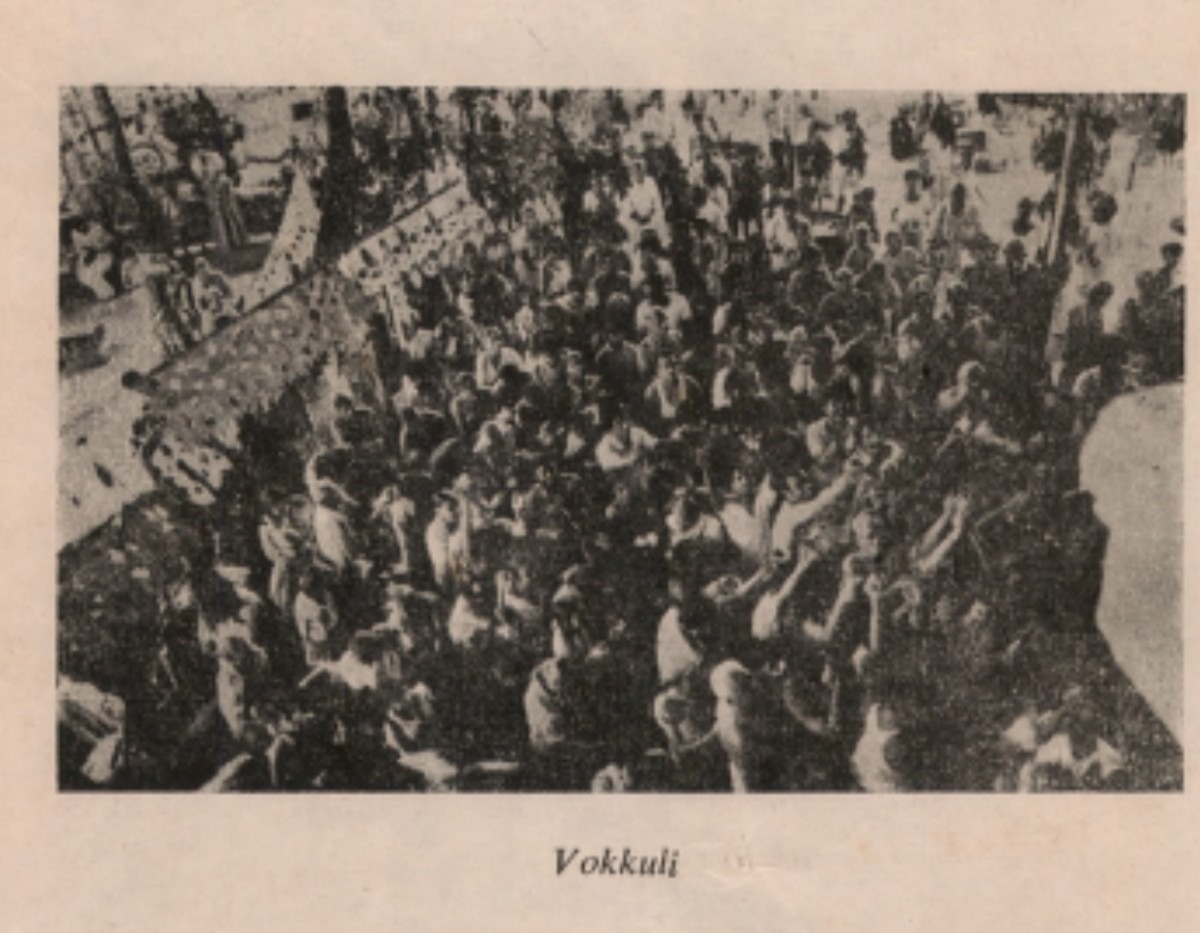
The reinstallation ceremony of the present Dhwajastambha
The Dhwajastambha was replaced on 26th February, 2003, under the guidance of H.H. Shrīmat Sadyojāt Shaṅkarāshram Swāmījī, with the trunk of a Vaṭāmbe tree, measuring 33 feet, 3 inches, in length. It was consecrated in the Rājāṅgaṇa. It has a bronze protective covering with a cushion of several quintals of Til, to ward off deterioration of the wood. It has an ornamental brass base and a Pañchaloha Nandī at the top, which is the Divya Chaitanya of the Stambha.
The ornamental brass pīt͟ha (base) of the Dhwajastambha features a Kūrma or tortoise, symbolic of the dwitīya (second) Avatāra of Bhagawāna Vis͟hṇu. (Our purāṇa-s describe that in the Satyuga, the Samudra Manthana or the churning of the cosmic ocean took place in order to extract Amṛta. The Deva-s and Asura-s formed the two teams, with Vāsukī as the rope and Mount Mandāra as the churning stick, stabilised by the Kūrma at the base.) It stands for stability, steadfastness and the
The Bimba vigraha of Nandī had been taken down from the old Dhwajastambha with Bimba Shuddhi. It was accompanied by Kalā Saṅkocha, whereby the Divine Presence (Kalā) was withdrawn (Saṅkocha) by chanting mantra-s and enshrined in the Jīva Kalasha. Numerous pūjā-s and Homa-s were conducted, including a ceremonial snāna where kalasha-s containing specific ingredients were placed on colourful Maṇḍala-s for abhis͟heka and H.H. Swāmījī performed ārati.
This was followed by the Shayyā-Adhivāsa ceremony. Neatly folded layers of different types of cloth, including wool and silk, constituted a Shayyā (bed) for Nandī to rest upon. The next day, He was hoisted atop the Stambha to patiently wait upon His Master, Shrī Bhavānīshaṅkar. H.H. Swāmījī consecrated Nandī by performing abhis͟heka with the Jīva Kalasha enshrining the Jīva of Nandī. A short fireworks display marked this crowning moment and āratī was offered.
\
_(16).jpg)
Consecration and installation of the other Vigraha-s
The Vigraha of Shrī Rāmāñjaneya was installed at the base of the Dhwajastambha on Māgha Shukla Navamī 2008, at the same time as the consecration of the Sannidhi-s of Shrī Mahāgaṇapati, Devī Bhuvaneshwarī, Shrī Shaṅkarāchārya and Shrī Guru Pādukā. The Ks͟hetrapāla was earlier enshrined inside the Mat͟h, beside the Guru Pādukā Sannidhi but has now been moved to the current location closer to the Dhwajastambha. Everyday Bali pūjā is offered to Ks͟hetrapāla, Nandī and Tulasī after the pūjā at the Hoḍi Samādhi.
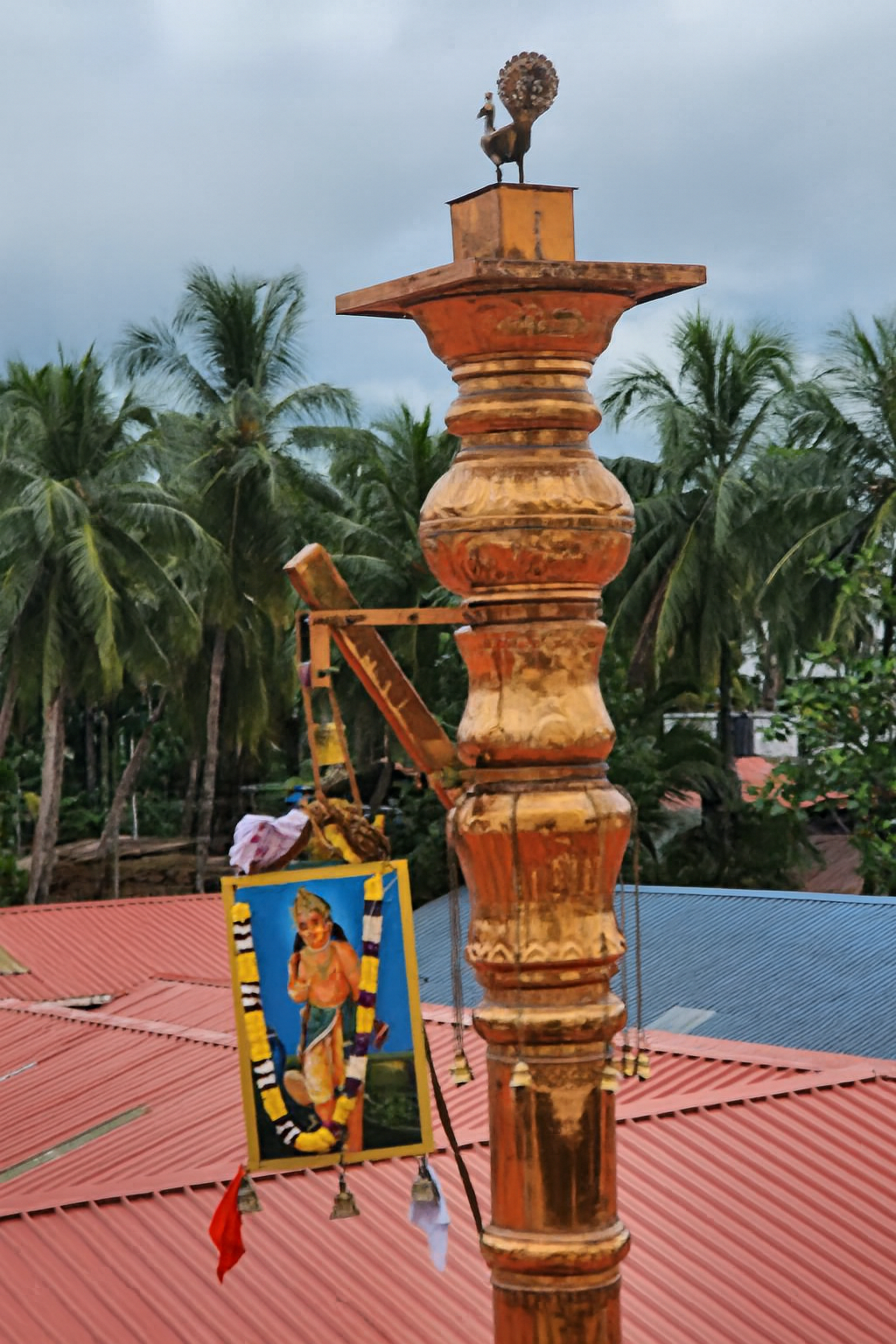
Dhwajastambha at Shrīmath Anantheshwar Temple (Viṭṭal)
At the Srīmath Anantheshwar Temple (Viṭṭal), Champā S͟has͟ht͟hī heralds the Teru, which commemorates the annihilation of Tārakāsura by Shrī Subrahmaṇya Deva. The Temple has a long and interesting history. Around the year 1560, one of our ancestors received a divine command, which led him to consecrate a temple to Shrī Anantheshwar at Vokketur. In 1660 in obedience to another divine command, the Deity was ceremoniously installed at Viṭṭal. Thus, the Rathotsava begins with a unique mṛttikā -haraṇa ritual before the Dhwajārohaṇa to commemorate this event. The Temple priests bring sacred soil from the Ādi-sthala at Vokketur and grains are sprouted Aṅkura in this soil as a part of the rituals and distributed as Prasāda after the Rathotsava.The Dhwajastambha here was replaced after 250 years under the aegis of H. H. Shrīmat Parijñānāshram Swāmījī III, in 1972. Thereafter, though a new Dhwajastambha had been installed in 2010, it was replaced exactly after a year on Vaishākha Shuddha S͟hash͟th͟ī, 2011 in the august presence of H.H. Shrīmat Sadyojāt Shaṅkarāshram Swāmījī. The new Dhwajastambha is clad in copper to safeguard it from weathering and features a peacock, the vāhana of Shrī Subrahmaṇya Deva, at the top. The Dhwaja features a beautiful picture of Shrī Kārtikeya on one side and Mahāshes͟ha on the other.
\
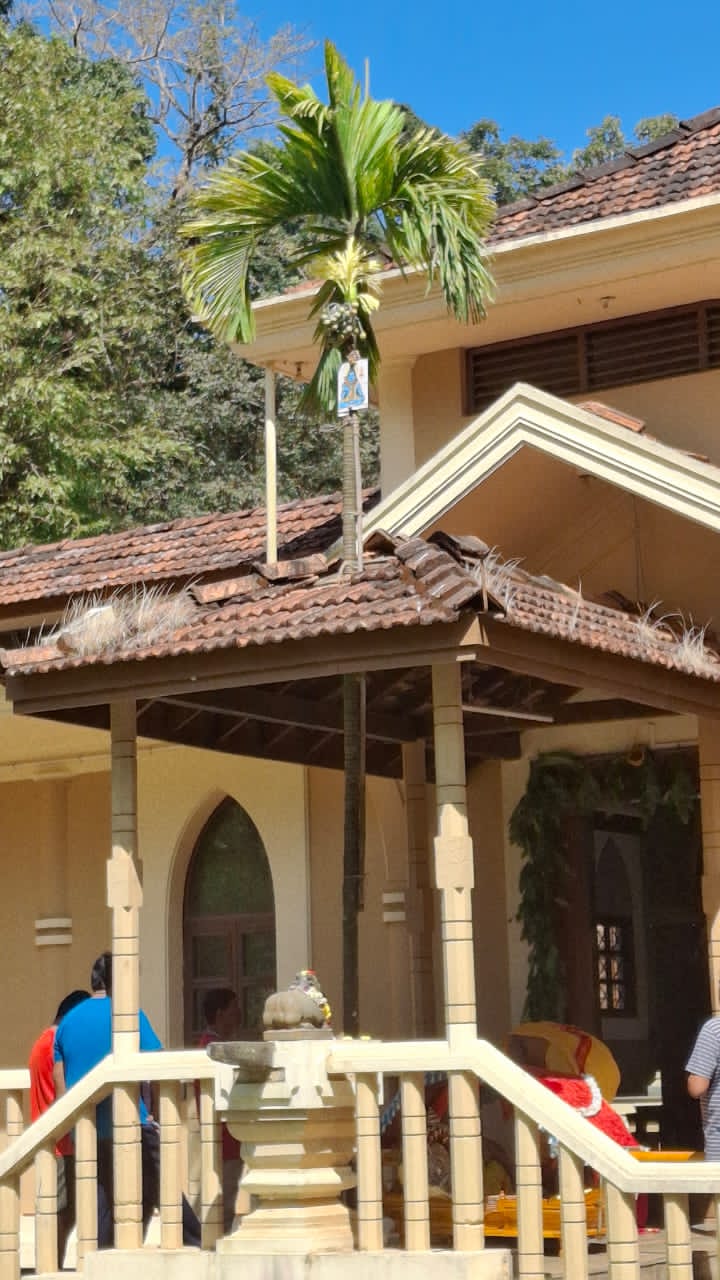
Dhwajastambha at the Shrīmat Subrahmaṇya Temple at Nīlekaṇī, Sirsī
Rathotsava is celebrated on Champā S͟hash͟th͟ī at the Shrīmat Subrahmaṇya Temple at Nīlekaṇī, Sirsī too. It is unique inasmuch as it doesn't have a permanent Dhwajastambha. There is a pit in front of Nandī where the Dhwajastambha is erected before Rathotsava. A supārī tree, laden with fruit and of an appropriate girth to fit the pit, is selected from the farm to serve as the Dhwajastambha. The Dhwajārohaṇa takes place after Vanabhojana. Here, Shrī Subrahmaṇya’s Dhwaja is emblazoned with an image of Nandīvāhana Shiva. He spreads an umbrella of protection over all that He surveys sitting atop the Dhwajastambha, while Shrī Subrahmaṇya sojourns into the village to meet His devotees.
During the Rathotsava, the Dhwaja at the top of the Stambha, with its tinkling bells, beckons the devotees to come forth and celebrate joyously while propitiating the Devatā.